
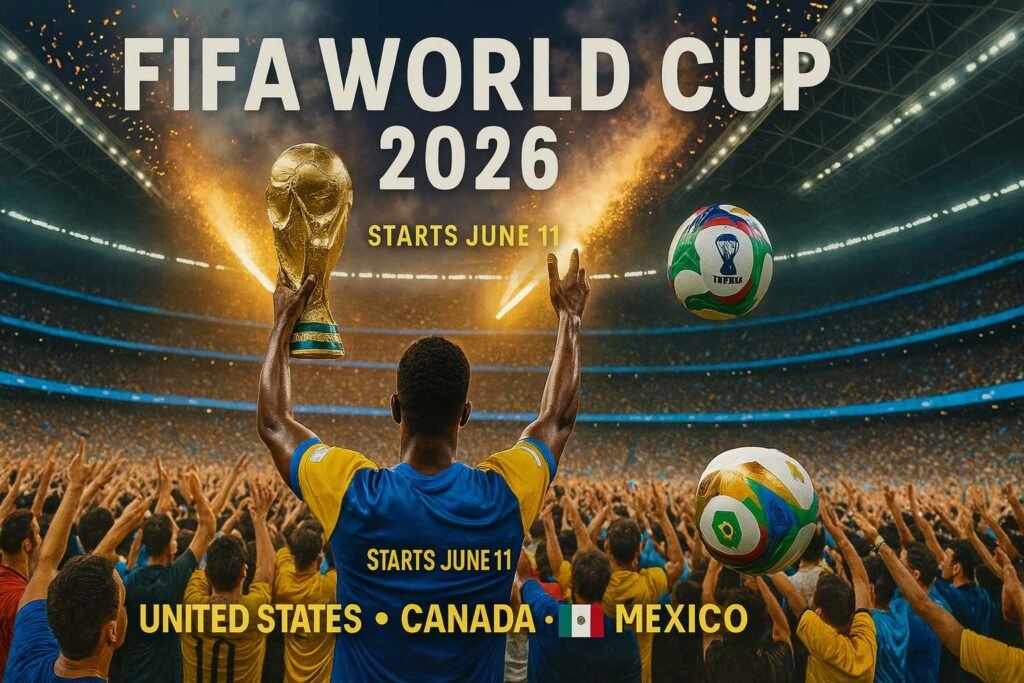
The biggest edition in tournament history: FIFA 2026 World Cup
The 2026 FIFA World Cup will be the biggest edition in tournament history—built on expansion, scale, and a truly continental hosting experience. For the first time, the finals will be staged across three countries: the United States, Canada, and Mexico. It also marks the start of the 48-team era, which reshapes both the competitive format and the global reach of the tournament.
Key tournament facts
Dates: June 11 to July 19, 2026
Hosts: United States, Canada, Mexico
Teams: 48
Matches: 104
Host cities: 16 across North America
Full Picture: What Makes World Cup 2026 Different
World Cup 2026 is different for three major reasons:
A tri-host World Cup
Instead of one nation owning the entire event, 2026 will feel like three connected festivals. That means more travel complexity for teams, more variety for fans, and three distinct football cultures shaping the atmosphere.
A 48-team field
More teams mean more storylines: first-time qualifiers, returning nations, and more “new matchups” that were previously impossible at the World Cup finals.
A longer, more demanding path to the trophy
In a bigger tournament, squad depth matters more. Teams must manage recovery, rotation, tactics, and discipline over a longer, higher-volume campaign.
Tournament Structure and Format (Simple Explanation)
The 2026 format expands the tournament while keeping the core drama intact:
A large group stage determines advancement
The tournament then transitions into a high-pressure knockout phase
The overall structure is designed to create more matches without losing the “one bad day can end your dream” intensity that defines the World Cup
The takeaway: the best teams won’t just be talented—they’ll be the ones that stay consistent across more matches, more travel, and more pressure.
Qualification Snapshot (Broad Update)
A) Teams already qualified (as of Nov 30, 2025)
At this stage, 42 of the 48 spots are filled. Here’s the broad breakdown of who has already booked a place at the finals:
World Cup hosts (auto-qualified)
United States
Canada
Mexico
AFC (Asia)
Iran, Uzbekistan, South Korea, Jordan, Australia, Japan, Qatar, Saudi Arabia
CAF (Africa)
Morocco, Egypt, Tunisia, Ghana, Cabo Verde, Algeria, South Africa, Senegal, Ivory Coast
CONCACAF (North/Central America & Caribbean)
Haiti, Curaçao, Panama
CONMEBOL (South America)
Argentina, Brazil, Ecuador, Colombia, Paraguay, Uruguay
OFC (Oceania)
New Zealand
UEFA (Europe)
England, France, Croatia, Portugal, Norway, Germany, Netherlands, Switzerland, Scotland, Spain, Austria, Belgium
B) Who is still in the playoff stage?
Six places remain and will be decided via playoffs.
Intercontinental playoffs (6 teams competing for 2 spots)
Bolivia
DR Congo
Iraq
Jamaica
New Caledonia
Suriname
UEFA playoff phase
Europe’s remaining spots are decided through UEFA’s own playoff pathways (separate from the intercontinental playoffs). This includes a larger playoff pool that determines Europe’s final qualifiers.
Refereeing and VAR: What Could Be New in 2026
Refereeing innovation continues to evolve. In 2026, the major theme is not “more technology for show,” but better consistency and fewer match-defining errors.
What fans are likely to notice:
More refined VAR workflows aimed at faster, cleaner decisions
Continued use and improvement of offside technology
Increased emphasis on clarity, transparency, and control in high-stakes moments
The objective is straightforward: reduce avoidable controversy and keep results decided by football—not confusion.
Co-Host Series: Co-Host 1 — United States (Venues, Matches, Team, Key Players)
The United States is the tournament’s primary hosting hub. In terms of operational scale, this is where the World Cup “lives” for most of the competition.
USA host cities / venues
The United States hosts matches across 11 cities:
Atlanta, Boston, Dallas, Houston, Kansas City, Los Angeles, Miami, New York/New Jersey, Philadelphia, San Francisco Bay Area, Seattle.
How many matches will be in the USA?
The USA will host the largest share of matches. This includes the tournament’s biggest moments—most importantly, the Final in New York/New Jersey.
USA World Cup identity (what to know)
USA’s historical World Cup legacy has had peaks and rebuilding phases, but the modern generation is built around athleticism, intensity, and a faster, more transition-driven style—especially on home soil with a crowd behind them.
Key players to watch (core names)
Christian Pulisic
Weston McKennie
Tyler Adams
Gio Reyna
These names represent USA’s attacking punch, midfield energy, and match-control spine.
Co-Host Series: Co-Host 2 — Canada (Venues, Matches, Team, Key Players)
Canada’s co-hosting role is a major milestone in the country’s football story—and 2026 is their biggest global platform yet.
Canada host cities / venues
Canada hosts matches in two cities:
Toronto
Vancouver
Matches in Canada
Canada hosts a focused set of matches compared to the USA, but these fixtures are high-impact in atmosphere—because host-nation games lift crowd intensity dramatically.
Canada’s World Cup identity
Canada’s modern football growth has accelerated in recent years. The team’s reputation is increasingly defined by speed, direct attacking bursts, and big-moment confidence—especially when backed by home support.
Key players to watch
Alphonso Davies
Jonathan David
Stephen Eustáquio
Co-Host Series: Co-Host 3 — Mexico (Venues, Matches, Legacy, Key Players)
Mexico is one of world football’s most recognizable World Cup nations—and one of the most emotional hosts you can imagine. Their stadium culture doesn’t just support the event—it amplifies it.
Mexico host cities / venues
Mexico hosts matches in three iconic venues/cities:
Mexico City
Guadalajara
Monterrey
Matches in Mexico
Mexico hosts a strong slate of fixtures, including high-profile group games and moments that typically become tournament highlights because of atmosphere.
Mexico’s World Cup legacy
Mexico carries deep World Cup continuity—frequent qualification, high tournament experience, and a fan culture that makes even neutral matches feel like events.
Key players to watch (modern pillars)
Hirving Lozano
Edson Álvarez
Santiago Giménez
TRIONDA: The Official Match Ball and How FIFA Is Highlighting It
A World Cup match ball is never “just a ball.” It’s a symbol, a design language, and a technology platform—used across marketing, broadcast visuals, fan engagement, and on-pitch performance.
What TRIONDA represents
TRIONDA is positioned as a World Cup 2026 signature object—designed to be instantly recognizable in photos, broadcasts, and highlights. FIFA and adidas have framed TRIONDA as part of the tournament’s identity build-up, launching it ahead of key international windows.
How TRIONDA is being highlighted
Integrated into the official tournament brand build-up and milestone announcements
Presented as a centerpiece of pre-tournament momentum (especially leading into major match windows and the final draw period)
Designed to read clearly on camera and in promotional media—making it “broadcast-friendly” and marketing-forward
Why this matters for 2026
With more matches and more global attention, a distinct official ball becomes even more valuable. TRIONDA functions as:
A visual icon for 2026 content
A consistent brand element across three host nations
A central object for fan imagery, promos, and storytelling
Sources:
FIFA World Cup 2026 official tournament pages (match schedule and official match ball announcement); FIFA World Cup 2026 qualification updates (“who has qualified” listings); reputable World Cup qualification reporting summarizing FIFA’s published qualification outcomes and playoff participants.